Thursday, May 11, 2017

The Jungle Book


The Jungle Book. By Rudyard Kipling.  Illustrated by Kurt Wiese and William Henry Drake.  Everyman's Library, 1894.  216 pages.

Ask most people if they've read The Jungle Book, and you'll get the same answer: "No, but I've seen the movie."  Well if that's you, prepare yourself for something completely different: this is definitely not Disney!  Rudyard Kipling's classic tale is filled with darkness.  Death is a constant presence, lurking in the shadows waiting for a chance to pounce.  In Kipling's version, the jungle-dwellers know that any moment of weakness can bring about their own violent downfall, and even the strongest of them understand that the time will come when age and weakness will leave them vulnerable, perhaps even to their own pack.

 This is the world into which the young "Man-cub" Mowgli is thrust after his parents are forced to abandon him as they flee from the man-eating tiger, Shere Khan.  Mowgli is discovered by Mother and Father Wolf, who decide to to keep Mowgli and raise him as their own.  According to the Law of the Jungle, they must introduce the child to the wolf pack and ask approval to keep him.  While the wolves ultimately agree to let young Mowgli remain with them, Shere Khan insists that the boy is his by rights, and swears that he will one day kill him.  Mother Wolf, on the other hand, claims it is Mowgli's destiny to grow up and kill Shere Khan.
Illustration from The Jungle Book (1894)

Many things will come to pass before their fates will be decided.  Mowgli is put under the protection of the great black panther, Bagheera, a powerful hunter who fears no one in the jungle.  Baloo, the bear, becomes Mowgli's teacher, tutoring him in the Law of the Jungle.  In marked contrast to the movie versions, the giant python Kaa is not one of Mowgli's enemies, but rather comes to his aid when he is in danger (Although, you never can be too sure about snakes, can you?).


Mowgli and his adopted family know that one day he will have to return to the world of men, but before that time comes Mowgli will have many adventures and meet up with every type of animal, from the Bandar-log (monkey people) who know no law, to the conniving jackal Tabaqui.  Mowgli learns the ways of the jungle, and is able to communicate with all of the animals.  He gets into and out of danger, often calling on the creatures for help.  In the end, Mowgli has to decide which destiny to pursue: destroy Shere Khan, or take his place in the world of men.
Illustration from The Jungle Book (1894)


Interwoven into these tales are the equally enjoyable but unrelated stories of The White Seal and Rikk-Tikki-Tavi, the cobra-killing mongoose (among others).  Masterpieces of children's literature and triumphant feats of imagination, these stories have held the attention of young and old alike for more than a century.  Give them a try and you'll come to learn what good readers already know: the book is always better!

Rikki-Tikki-Tavi. Illustration from The Jungle Book (1894)

Tuesday, May 9, 2017

When Zachary Beaver Came to Town


When Zachary Beaver Came to Town. By Kimberly Willis Holt. Dell Yearling, 1999.  227 pages.  $6.38 (Paperback)

"Nothing much ever happens in Antler, Texas.  Nothing much at all.  Until this afternoon, when an old blue Thunderbird pulls a trailer decorated with Christmas lights in to the Dairy Maid parking lot.  The red words painted on the trailer cause quite a buzz around town, and before an hour is up, half of Antler is standing in line with two dollars clutched in hand to see the fattest boy in the world."

Toby and his best friend, Cal, are getting ready to head back to school near the end of another uneventful summer, when a new sensation arrives in town that will have an unexpected impact on both of their lives.  Zachary Beaver, billed as "the fattest boy in the world," weighs six hundred and forty-three pounds and travels the country in a trailer, charging curious spectators for a glimpse of his prodigious girth.  When Zachary is deserted by his caretaker, the boys find themselves thrust into an unwanted friendship with the enormous boy.  Zachary is often rude and surly, and seems to harbor many secrets, and Cal and Toby see him as a burden at first.  Little by little, however, Zachary lowers his guard and reveals himself to be much more complex than he first appears.

Meanwhile, Toby, the narrator of our tale, has other worries.  Like how to get Scarlett, the pretty blonde girl from his school, to think of him as more than a friend (while avoiding her menacing boyfriend, Juan).  Not only that, but Toby's mom has left the family in Texas to enter a singing contest in Nashville, and Toby notices some disturbing signs that seem to indicate that she may not be planning to return.

Set in the early seventies against the backdrop of the Vietnam War, this surprisingly complex book is often funny, and occasionally quite sad.  It is a story about the complexities of friendship and the difficulty of fitting in.  A winner of the National Book Award, this is a story anyone can relate to: it documents that awkward period between childhood and adulthood that can be one of the most difficult periods in anyone's life.  At the same time, it is a story about a (literally) larger than life character that is utterly unique in the world of fiction.

Friday, April 28, 2017

Freedom Riders: John Lewis and Jim Zwerg on the Front Lines of the Civil Rights Movement


Freedom Riders: John Lewis and Jim Zwerg on the Front Lines of the Civil Rights Movement. By Ann Bausum. National Geographic Society, 2006.  79 pages.  $18.95

"Captured in the pages of this book is a compelling moment in human history, the drama of the Freedom Rides, the most untold story of the civil rights movement.  This is a true account of courageous Americans who were prepared to dis for what they believed."  So says civil rights leader John Lewis in his forward to Freedom Riders: John Lewis and Jim Zwerg on the Front Lines of the Civil Rights Movement, a Robert F. Sibert Honor book.  This fascinating book begins with an examination of the era preceding the civil rights movement from both the African American and white perspective by detailing the childhoods of the Lewis and Zwerg.  It goes on to show how these two men, one black and the other white, became leading figures in the Civil Rights Movement of the 1960's through their participation in the Freedom Rides, in which activists from different parts of the country rode buses into the Deep South to confront racial injustice.  Adhering firmly to their non-violent principles, they nevertheless faced great dangers as they attempted to bring the message of equality for all into the most segregated parts of the United States.

The passages about Lewis's childhood are especially moving.  Growing up in the heart of the Jim Crow era, Lewis was confronted daily with his "otherness": the sense that he was trapped in a society in which he could never be accepted.  He talks about his anger and his shame at having to attend segregated schools with no playgrounds, no indoor plumbing, and hand-me-down books.  These early experiences were the forge in which Lewis developed the strength to confront injustice; he became one of the leaders of the Civil Rights Movement as a very young man, and, as a congressman from the state of Georgia, he continues to fight for equal rights for all people to this very day.

Zwerg, by contrast, "might as well have been born into another world." He had very little interaction with other races growing up, but his parents taught him respect for all people, regardless of their differences.  In college, Zwerg was a natural leader, and when the Civil Rights Movement began to gain momentum his deep sense of right and wrong compelled him to act.

John Lewis and others confront police on Bloody Sunday
Retrieved from https://c1.staticflickr.com/2/1697/23854979734_8f8582ed45_b.jpg


The two men would go on to face all manner of prejudice side-by-side.  They were confronted by angry mobs armed with baseball and hammers; they heard the most hateful of racial epithets; and they mourned when some of their fellow protesters we're killed by bigots.  But they also witnessed and participated in some of the pivotal moments in this nation's history, and in the end, heroes like Lewis and Zwerg persevered and helped to bring about lasting change and a greater degree of equality for all Americans.  This book is a reminder that a few a determined individuals can make a difference in the face of great injustice.  It is also a reminder that we have a responsibility to do so.

Highly Recommended: Award-Winning Books


Click on the thumbnail below to view my presentation on award-winning children's and young adult books:


Thursday, April 27, 2017

The Graveyard Book

The Graveyard Book. By Neil Gaiman. Illustrated by Dave McKean. Harper Collins, 2008.  312 pages.  $11.99


Introduction to Neil Gaiman's The Graveyard Book

"There was a hand in the darkness, and it held a knife.."  So begins the strange and thrilling tale of Nobody Owens, better known as Bod.  When his parents are murdered while he is still an infant, the remarkable Bod somehow manages to escape... to a graveyard.

There, young Bod comes under the protection of the graveyard's residents (some of whom have been dead for more than one thousand years!), who decide to adopt Bod and raise him as their own.  Bod's upbringing is overseen by the mysterious Silas, who arranges to for Bod to learn not only his ABCs, but the shadowy ways of the dead as well.

Bod meets many strange beings, from ghouls and witches to night-gaunts, Sleers, and Hounds of God.  Some of these creatures mean him well, while others mean him harm, but Bod always seems to escape from danger in the nick of time.  But there are things in Bod's background that even he does not know about, and dangers are lurking, waiting for their chance to pounce.


This action-packed book is enlivened by the stylized illustrations of Dave McKean.
Illustrations from The Graveyard Book (Gaiman, 2008)


Now that you've read my introduction, you can view my read-aloud from Chapter 1 here:


Friday, April 21, 2017

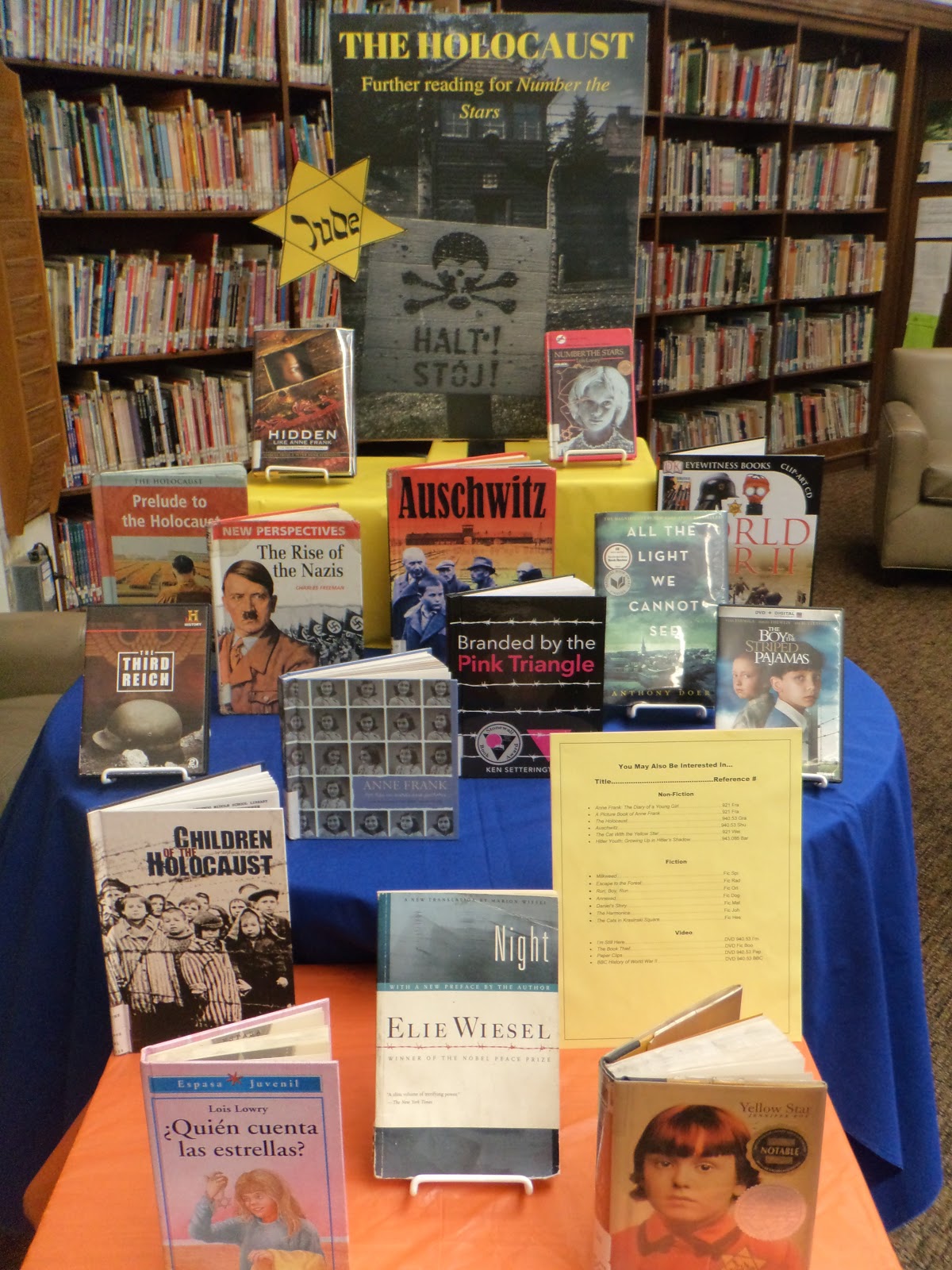
The Holocaust: Further Reading for Number the Stars


If you need help on your research project, or just want to learn more about this fascinating and horrifying period in history, come by the library and check out our display.


Thursday, April 20, 2017

Number the Stars


Number the Stars. By Lois Lowry. Bantam Doubleday Dell Books for Young Readers, 1989. 137 pages. $11.00

"'Halte!' the soldier ordered in a stern voice...'Why are you running?'"  Ten-year-old Annemarie Johansen and her best friend, Ellen, were just two young girls racing each other to the corner.  They did not realize that their lives were about to change forever.

Lois Lowry's Number the Stars is set in Copenhagen, Denmark, shortly after it was occupied by Hitler's Nazis during WWII.  Before the German invasion, Annemarie and her friends and family had known only peace and happiness, but now they were faced with daily specter of soldiers in the streets, with their shining black boots and their rifles slung over their shoulders.  Still, they do their best to carry on with a normal life.  But one day, they learn that the Nazis are rounding up all the Jews in Copenhagen for "relocation"... and Annemarie's best friend, Ellen, is Jewish.

Annemarie and her family make a commitment to help Denmark's Jews escape a terrible fate, but they do so only  at great danger to themselves.  As the Nazis close in on Ellen and her family, the Johansens involve themselves in a desperate plan to save them.  If they are caught, they could all be arrested.  Or worse.

Lowry's fast-paced story races along to a dramatic climax.  Will Ellen and her family escape to safety?  Will Annemarie and the Johansens be able to avoid detection?  This book will keep you in suspense right up to the end.  In the process, you will see examples of great courage and boundless compassion.  This book is ultimately a reminder that we are indeed each others' keepers, and that we have a duty to our fellow men and women, regardless of whether we share the same faith or the same ethnicity.  Although this is not a true story, it was inspired by the very real heroism of the Danish people, who were able to save most of their country's Jews from the horrible fate the befell the Jews of almost every other country in Europe.  This is a memorable and inspiring book that will appeal to a wide range of readers.